
February 14, 2013
Genealogy Gold Mining
I have been swamped with work as I prepare to launch my next book (March 4), so my lovely daughter agreed to let me post one of her articles on genealogy. Aliza is a syndicated columnist and feature writer for Italian American publications across the US. I’m sure you’ll enjoy the post. This article was originally published in La Voce (Las Vegas, NV), La Voce Italiana (Houston, TX), La Gazzetta Italiana (Cleveland, OH)
Giacomo
Bringing Your Family Tree to Life
 by Aliza Giammatteo
A friend who had recently lost a close relative posted on his Facebook page last month how sad it was that he would never be able to know personal details about his ancestors’ lives, like: what they looked like, how they really lived, etc. (In his grief, he must’ve forgotten that his friend list included a genealogist.)
I certainly understood his sentiment, especially in light of his recent loss, (and even more so as it was written in the context of a platform like Facebook where, if anything, we might have too much information on people); but I have to admit that the genealogist in me wanted to jump through the computer screen and announce “but you can learn those details!â€
Genealogical Gold Mining
I managed to keep the urge to delve into genealogical gold mining strategies at bay since it didn’t seem like the appropriate time, but my friend’s post got me thinking about how many times I’ve heard similar statements from clients over the years, which inspired me to share some of those “gold mining†tips here.
We can’t learn about our ancestors’ lives in minute detail like we can today on places like Facebook, but you might be surprised at what kind of things you can discover if you just know where and how to look.
Finding Photos of Your Ancestors
Finding old family photographs has to be at the top of the list of the most exciting things you can discover in a genealogy search.
Finding an “ancestry angelâ€, as I like to call them, (someone you meet in the course of a genealogy search who, as if by magic, provides you with a piece of the puzzle you were looking for) is one of the best ways to get old family photos. Thanks to things like online forums and social networks, it’s becoming more and more common to find ancestry angels. But if you don’t have an ancestry angel yet, try digging for photos on your own.
Fair warning: photos usually aren’t as easy to come by as your standard genealogy records (like a census record) but there are plenty of places where you might find one if you’re willing to dig a bit. Here’s a partial list: immigration/naturalization records (passport applications, for example), obituaries, yearbooks, tombstones (yes, some tombstones – in the US and in Italy – have images on them), military or society publications, newspaper articles, etc.
The well-known genealogy website, www.ancestry.com, is a good place to hunt for some of the records listed above, for US collections, that is (subscription required). Gravestones are more of a longshot but they’re worth a try. You might find other interesting family info in the process. Pictures of tombstones can be found – or requested – for free on the website: www.findagrave.com.
WW1 draft registration card for the author’s Great Grandfather, Giuseppe “Joseph†D’Angelo, with a physical description of him (circled in yellow). This was the first evidence the author had that family lore was correct and he had blue eyes. Some documents contain physical descriptions so it’s possible to learn what your ancestors looked like, even if no photos exist.
 No Photos? Get the Next Best Thing
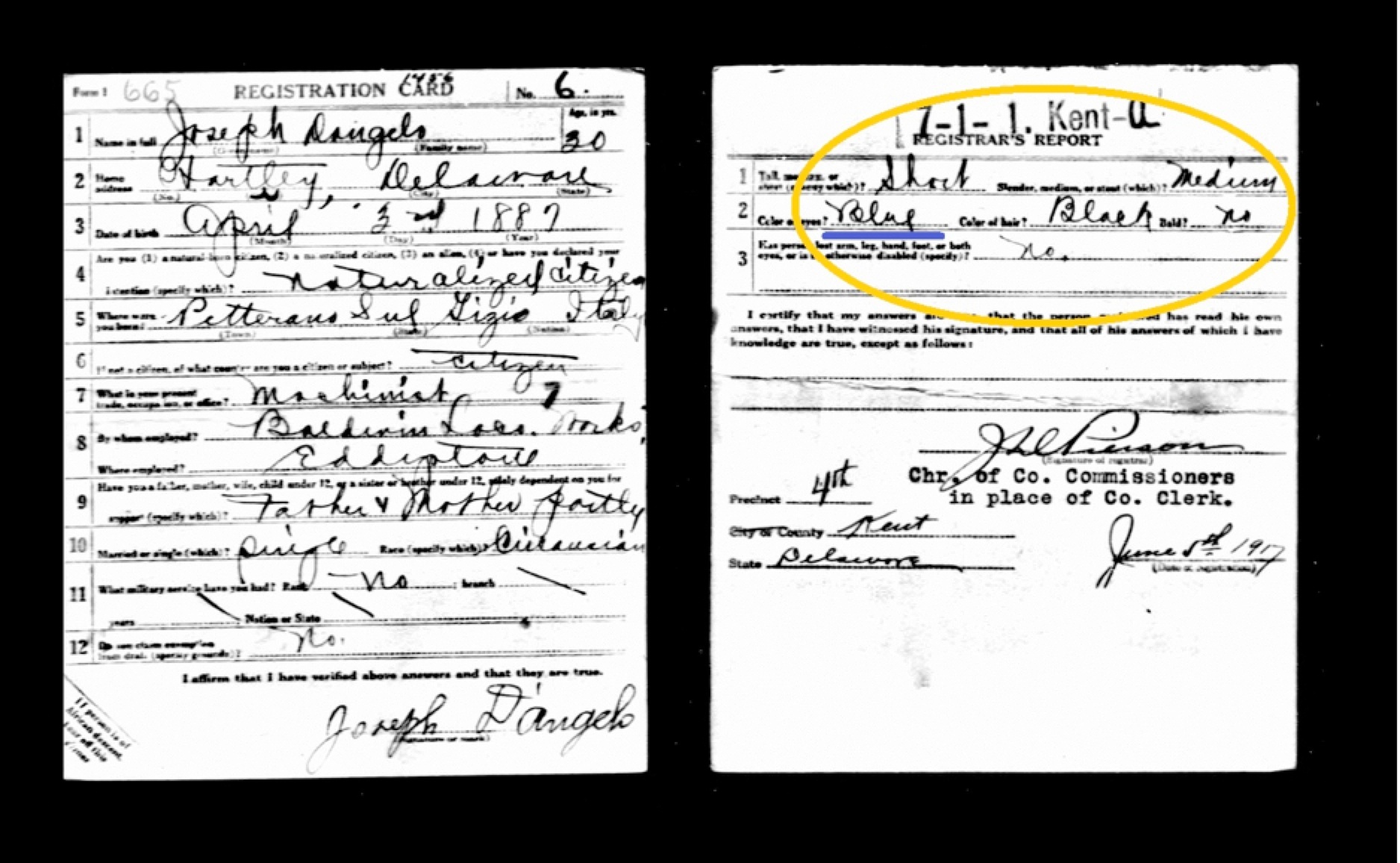
Sometimes you can find out what an ancestor looked like even without a photo. How is that? There are several types of records that contain physical descriptions.
Want to know how tall your ancestor was? Curious about their hair or eye color? Military records and ship manifests are good places to look for physical descriptions. If your ancestor came through Ellis Island, you can view their ship record for free at: www.ellisisland.org.
(Tip on military records: a common rookie mistake is to assume that just because someone didn’t actually serve in the military, there are no military records for them. Millions of men have military draft cards or registrations on file, even if they never served. That goes for Italy as well as the US.)
What Were My Ancestors Like? How Did They Live?
That’s a big, broad question and it deserves a big, broad answer; but since we can’t cover that in one article, here are a couple of things I can suggest to help bring your family tree to life:
Obituaries can be a great resource because they frequently list personal details that are only rarely found on other records, like: the person’s hobbies and interests, clubs or societies they belonged to, charitable activities, sports they played, etc. Some even have fun details, such as: their favorite places, foods, music, pets, you name it.
Census records contain a tremendous amount of information and can be a mini gold mine in and of themselves. Take the time to read each column and observe who the neighbors were, etc. Some have detailed employment information like: their salary, how many weeks a year they worked and how many hours a week. You can also see if they rented or owned their home and what the value of the home was (or how much they paid in rent).
Treasure Hunting
I often compare genealogy digs to treasure hunting because, in my view, family stories – not just names and dates, but the stories that tell us who our ancestors were – really are treasures. Very few, if any, material heirlooms could compare to passing that down; so when I discover a great story, I truly do feel like I’ve struck gold – and so do a lot of our clients.
“Gold Mining†Tip #1
But just like real gold mining, the genealogical kind takes some serious digging. That’s number one. Don’t expect it to be as easy as a google search. Yes, there are wonderful sites, like ancestry.com, that have billions of records online now, but that’s only the tip of the iceberg. The overwhelming majority of genealogy records are not online – and won’t be for a good, long time.
“Gold Mining†Tip #2
The second tip is the most important one: don’t expect to hit the jackpot by digging up one, massive gold nugget that gives you everything you’re looking for. Like real gold mining, you’re more likely to find a whole lot of small nuggets – flakes even – that add up to a jackpot when you mold them all together.
In other words, it’s usually only by combining a variety of different records for our ancestors that the picture of who they were emerges (with or without an actual photograph).
Does it take work? Absolutely. But is it worth it? Absolutely!
Because that’s where the true treasure is. That’s when, instead of being saddened that a family story was lost, forgotten – or maybe never passed down to begin with – you get to recover it, reclaim it, and gift it to the next generation. Not even gold can compare to that.
**
Aliza Giammatteo is the owner and lead researcher at Roots in the Boot, an Italian genealogy firm headquartered in Las Vegas, NV. She’s a syndicated columnist and feature writer for Italian American publications across the US. To learn more about your own roots in the Italian “bootâ€, visit: www.rootsintheboot.com, email: info@rootsintheboot.com, or call: (646) 255-9565.


Nice tips Aliza, I like your tips..especially the second one..”Like real gold mining, you’re more likely to find a whole lot of small nuggets”…haha
Sure people need to have professional skill and quite long hours of practice and do research to able getting that information. I do understand how hard to obtain spesific information about spesific person, you’re do awesome work here Aliza
Thanks for the comments. I’m glad you enjoyed it. I hope it’s helpful in your hunt.
Professional jobs: Yes, finding a bunch of small nuggets is usually how it works (though they can add up to a big one, as mentioned).
I always try to set the right expectations (whether my firm is doing a search for someone or we’re helping them do it on their own) so I though it might help to mention that. 🙂
Ahmad: Yes, it does take quite a bit of study and practice to be a respected, professional genealogist. My firm’s top experts all have a minimum of 15 years of experience — almost exclusively in our specialty (Italian) — and we still learn new things every day!
So it’s definitely a profession for someone likes to learn!
Thank you for the compliment too.
Best wishes to you both,
Aliza Giammatteo
Aliza Giammatteo recently posted..“Ancestry Angels” You Never Knew You Had
Hai aliza, you’re do awesome work here Aliza
nice to meet u